
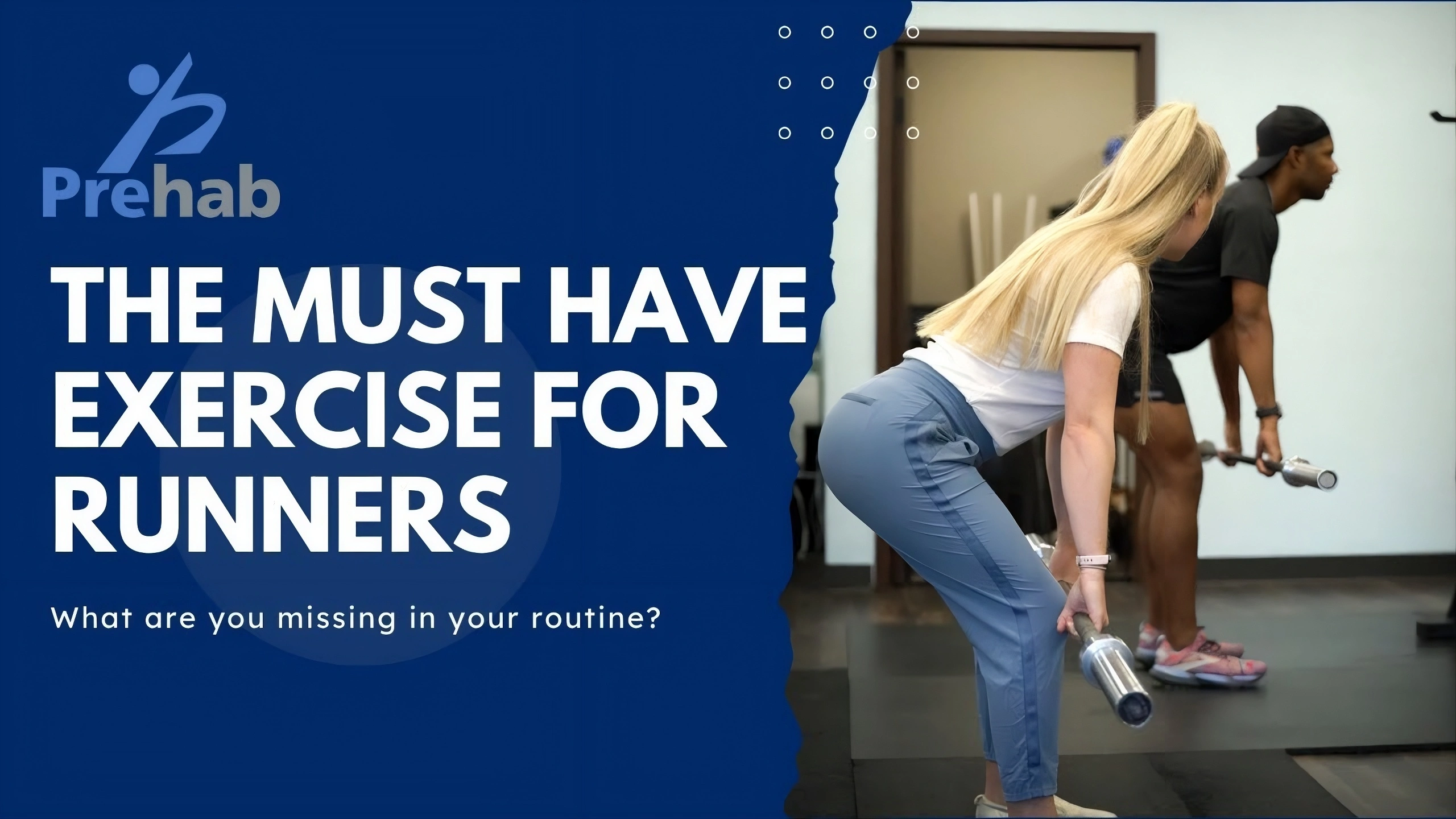
Running is fundamentally a series of single-leg plyometric bounds. Every single time your foot hits the ground, your body has to absorb several times its weight, stabilize the pelvis, and efficiently transfer force to propel you forward.
Because running places such high unilateral demands on the body, your strength training routine needs to mirror that reality.
At Prehab, we look at movement through a preventative and corrective lens. If you have to pick just one lower-body exercise to optimize your running mechanics and mitigate injury risk, make it the Single-Leg Romanian Deadlift (SL RDL). Here is a clinical breakdown of why this hinge variation is a non-negotiable for running injury prevention and how to execute it with perfect form.
Watch on YouTube: https://www.youtube.com/watch?v=dy_Y_mVqAhE
Why Every Runner Needs the Single-Leg Romanian Deadlift
While standard bilateral deadlifts are excellent for building absolute power, the single-leg variation specifically targets the biomechanical vulnerabilities that athletes face on the road or trail. Incorporating the single-leg RDL into your program delivers targeted benefits:
- Fixes Left-to-Right Muscle Asymmetries: Running can easily mask side-to-side strength deficits. Isolating each limb forces you to identify and address imbalances before they manifest as overuse injuries.
- Improves Pelvic and Core Stability: Hinging on one leg forces the gluteus medius and deep core stabilizers to work dynamically. This prevents the lateral pelvic drop (or “hip dip”) that frequently causes runner’s knee and lower back pain.
- Optimizes Foot and Ankle Kinematics: Stripping away the support of a second foot forces the intrinsic muscles of your foot and ankle to work overtime to anchor you, building a more resilient foundation for ground impact.
- Strengthens the Posterior Chain: The movement targets the hamstrings and glutes in an elongated state. This builds the eccentric capacity required to handle the high deceleration forces during the stance phase of your running stride.
Single-Leg RDL Form Breakdown & Technique Cues
To get the full preventative and performance value out of this movement, execution has to be precise. Remember: this is a pure hip hinge, not a squatting movement.
- The Starting Position: Stand tall on one leg with a “soft” knee (a slight flexion of about 10–15 degrees). Lock your foot into the floor using a tripod cue—pressing firmly through the big toe, pinky toe, and heel.
- The Hinge: Initiate the movement by driving your hips straight back, rather than thinking about lowering your torso down. Your non-working leg should extend backward in a straight line with your spine, acting as a counterweight.
- The End Range: Stop when your torso is roughly parallel to the floor, or when you feel your hamstrings reach maximum tension. Your hips must remain perfectly square to the floor throughout; do not let the pelvis rotate open.
- The Drive: Push through the middle of your standing foot, squeeze your glutes, and drive your hips forward to return to the upright starting position.
Common Pitfalls to Avoid: Do not let the lumbar spine round in an effort to reach closer to the floor. Depth is determined by hip mobility, not spinal flexion. If you lose your balance, focus your gaze on a fixed point on the floor about 3–4 feet ahead of you.
Biomechanical Loading and Progression of the SL RDL
In athletic training protocols, individuals initiating single-leg strength work or managing rehabilitation constraints typically begin with unweighted variations. This allows the nervous system to prioritize proprioception (spatial awareness) and multi-planar movement control without extra stress.
Standard progression tracking involves verifying consistent structural alignment and movement control before introducing external resistance. When adding load, placing a kettlebell or dumbbell in the hand opposite the stance leg creates a contralateral load. This specific configuration places a high demand on core rotational stability and alters the functional force vectors acting on the lower body.
Disclaimer: This blog is intended for educational purposes only and should not replace individualized medical or nutrition advice. Always consult with a qualified healthcare provider or registered dietitian for recommendations specific to your needs and training goals.
Why rehab when you can Prehab?
Up Your Game With A Prehab Free Discovery Visit
