
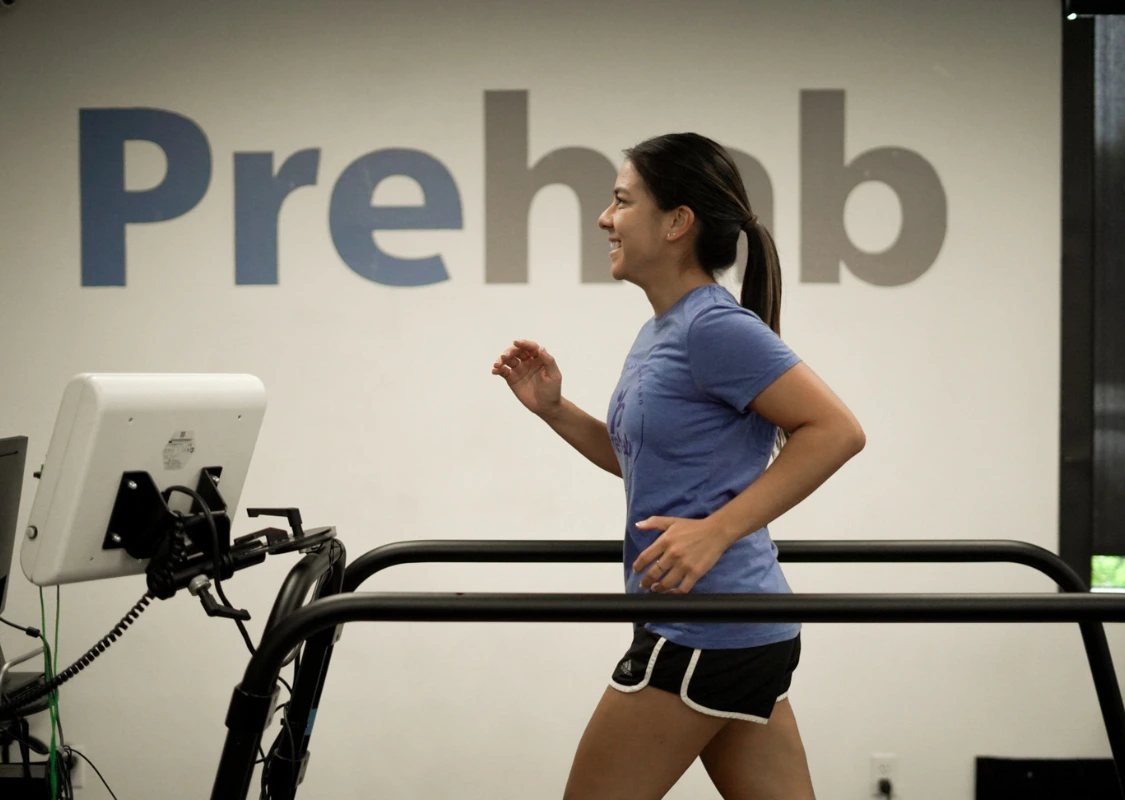
If you’ve ever analyzed your running metrics or talked biomechanics with a physical therapist, you’ve probably come across the term vertical displacement (sometimes called vertical oscillation). This measures how much your body moves up and down with each stride.
A lot of runners see high vertical displacement on their GPS watches and assume any upward motion is wasted energy. The common assumption is that staying as flat and level as possible is the key to running efficiency.
Here’s the reality: The goal isn’t zero vertical displacement; it’s the right amount.
At Prehab, we look at running mechanics through a functional lens. Trying to completely eliminate vertical displacement isn’t just unrealistic—it actually works against your body’s natural mechanics. Your tendons, especially your Achilles and plantar fascia, are designed to function like springs. They require a specific amount of vertical compression to store elastic energy and propel you forward into your next stride.
- Too much bounce sends your energy skyward instead of forward, wasting precious stamina.
- Too little bounce creates a stiff, rigid stride, forcing your muscles to work harder than your tendons and lowering overall power output.
Finding the optimal balance allows you to run faster, absorb impact better, and conserve energy over long distances.
4 Prehab Exercises to Optimize Vertical Displacement
Improving your stride mechanics comes down to building tendon stiffness, single-leg stability, and efficient force production. Integrate these targeted exercises into your training routine to find your optimal vertical displacement.
1. Pogo Hops (For Elastic Recoil)
Pogo hops train your lower legs and ankles to act like reactive springs, helping you absorb impact quickly and rebound off the ground.
- How to do it: Stand tall with your feet hip-width apart. Hop off the balls of your feet with minimal knee bend, focusing on keeping your ground contact time as short as possible.
- When to do it: 3 sets of 15–20 seconds as part of your dynamic pre-run warm-up.
2. Single-Leg Isometric Calf Holds (For Load Capacity)
Before your tendons can spring back, your calves and ankles must be strong enough to withstand impact without collapsing.
- How to do it: Stand on one leg on the edge of a step. Press up onto your toes and hold that top position with full control.
- When to do it: 3 sets of 20–30 seconds per leg on your strength training days.
3. Box Step-Ups with Knee Drive (For Triple Extension)
This drill builds functional strength by teaching you to drive force into the ground while keeping your torso and hips stable.
- How to do it: Step onto a sturdy box or bench. Drive down through your midfoot to stand tall, bringing your trailing knee up toward your chest in a running motion. Step down with control.
- When to do it: 3 sets of 8–10 reps per leg during strength sessions.
4. Running A-Skips (For Gait Mechanics)
A-skips bridge the gap between strength training and running form, helping your body rhythmically calibrate proper ground contact.
- How to do it: Skip forward rhythmically, lifting your lead knee toward hip height and snapping your foot down directly under your center of mass.
- When to do it: 2 to 3 sets of 20 meters before track workouts or tempo runs.
How to Work These Drills Into Your Running Routine
At Prehab, we emphasize simple, effective programming:
- Before Your Run: Use reactive drills like Pogo Hops and A-Skips in your dynamic warm-up to prime your nervous system and tendons.
- After Your Run / Gym Days: Program strength-focused movements like Single-Leg Calf Holds and Box Step-Ups into your post-run routine or strength days.
By targeting the right amount of vertical displacement, you can run lighter, reduce stress on your joints, and build a more resilient stride for the long haul.
Disclaimer: This blog is intended for educational purposes only and should not replace individualized medical or nutrition advice. Always consult with a qualified healthcare provider or registered dietitian for recommendations specific to your needs and training goals.
Why rehab when you can Prehab?
Up Your Game With A Prehab Free Discovery Visit