
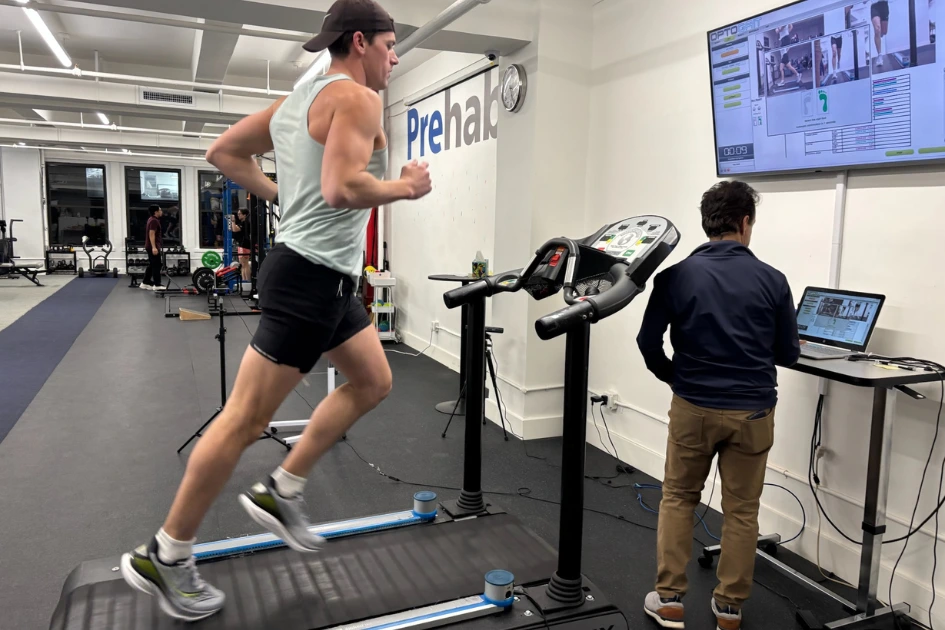
If you are wondering about the ideal running forward lean when building your stride, you will probably get five completely different answers from five different runners. Some swear by standing as tall as possible, while others tell you to lean into gravity to get free speed.
The truth? There is no single universal angle that works for everyone. At Prehab, we see firsthand that the ideal forward lean isn’t about hitting a magic number on a protractor—it comes down to how your body produces and absorbs force on the pavement.
Why Forward Lean Matters for Runners
A proper running forward lean is a fundamental part of efficient running mechanics. However, a common mistake is bending at the waist. A proper lean originates from the ankles, keeping your hips, spine, and neck in alignment.
When done correctly, leaning forward gives your stride a few key advantages:
- Reduces Braking Forces: Landing with your feet too far in front of your body acts like pulling a handbrake with every step. A proper ankle lean helps keep your foot strike closer to your center of mass.
- Improves Propulsion: Shifting your weight forward allows you to capitalize on momentum, taking some of the heavy lifting off your quads and hip flexors.
- Distributes Impact: Correct alignment helps load the posterior chain—your glutes, hamstrings, and calves—where your largest muscles can absorb the impact of the ground.
Subtle vs. Aggressive Lean: Finding Your Strategy
Because every runner has different strength levels, flexibility, and stride styles, the amount of lean that feels natural will vary.
The Subtle Lean
A mild forward angle works exceptionally well for runners who rely on a high cadence and vertical energy return. If you have strong tendon stiffness and bouncy mechanics, staying relatively upright helps you pop quickly off the ground without wasting energy. Over-leaning in this style can throw off your rhythm and strain your lower back.
The Aggressive Lean
A more pronounced lean is standard during acceleration or sprinting, but some distance runners naturally perform better with a bit more tilt. This posture relies heavily on horizontal force production to drive you forward. However, forcing an aggressive lean when your core and calves aren’t built to support it can lead to tight Achilles tendons, calf strain, or collapsing at the hips.
How Prehab Uses Data to Optimize Your Form
Trying to force your body into an arbitrary posture based on generic advice usually leads to compensation patterns and unnecessary injuries. Form follows function. Mastering your running forward lean depends entirely on your current strength, mobility, and force profile.
This is why objective gait analysis is so valuable. By evaluating real movement data—like ground contact time, foot strike angles, and force distribution—the Prehab team helps you stop guessing what your form should look like and start optimizing the form that actually works best for your body.
Want to optimize your running stride? Reach out to Prehab for a comprehensive gait analysis and a personalized movement plan designed to keep you running strong, efficient, and injury-free.
Disclaimer: This blog is intended for educational purposes only and should not replace individualized medical or nutrition advice. Always consult with a qualified healthcare provider or registered dietitian for recommendations specific to your needs and training goals.
Why rehab when you can Prehab?
Up Your Game With A Prehab Free Discovery Visit