
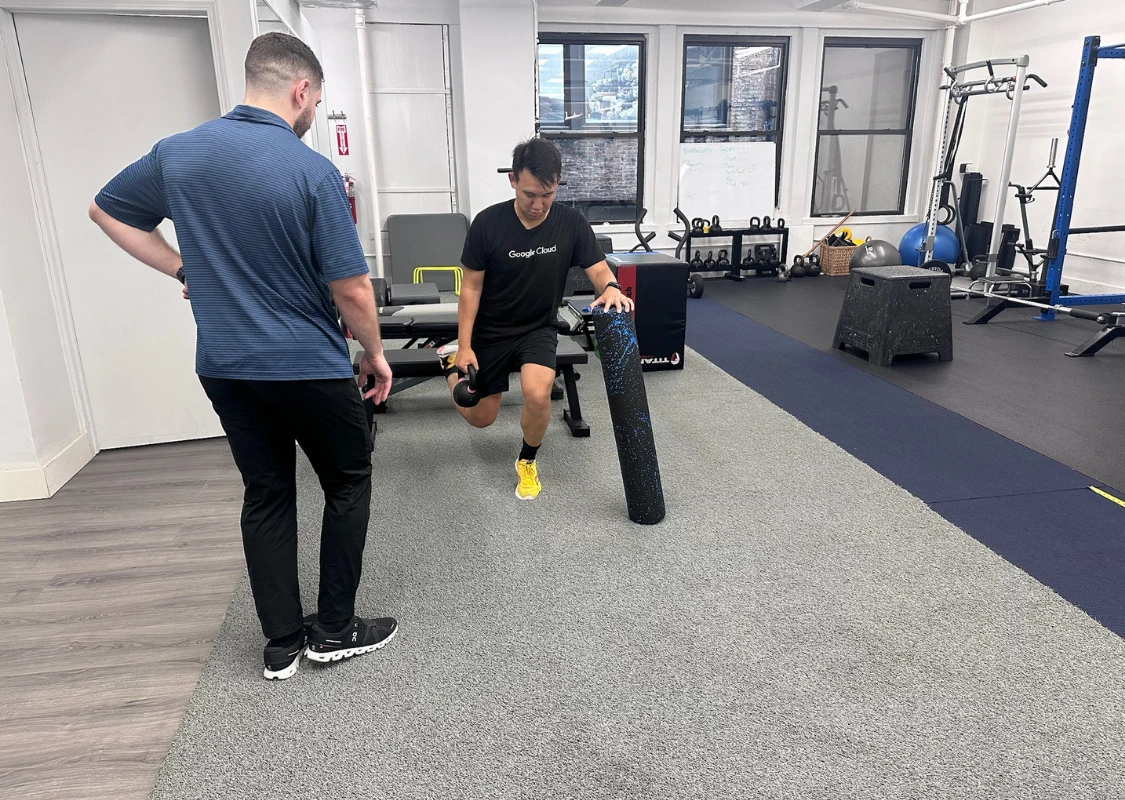
Quad strength is crucial for runners, especially if you want to tolerate higher training volume and handle hills, speed work, and longer runs.
At Prehab, we often see runners focus heavily on the posterior chain—glutes and hamstrings—while overlooking just how much work the quads do. When you hit a steep downhill or absorb the landing forces of a long stride, your quadriceps act as your body’s primary shock absorbers. Strong quads protect your knees, keep your joints healthy, and prevent your running mechanics from falling apart when fatigue sets in.
If you want to build durable, injury-resistant legs that can handle heavy mileage, here are four foundational quad exercises recommended by the Prehab team to add to your routine.
1. Rear Foot Elevated Split Squat
Running is essentially a series of single-leg bounds. The rear foot elevated split squat (or Bulgarian split squat) forces each leg to work independently, highlighting and fixing the strength imbalances that naturally develop over miles on the road.
Why it works: It builds deep quad strength while simultaneously improving hip flexor mobility on the trailing leg—a major win for overall running economy.
How to execute:
- Stand a few feet in front of a bench or box and place the top of your back foot on it.
- Keep your torso tall and lower your back knee toward the floor.
- Drive through the midfoot of your front leg to power back up to the starting position.
2. Front-Loaded Spanish Squat
If you struggle with knee sensitivity or patellar tendon irritation during high-volume training blocks, Spanish squats are a core Prehab favorite.
Why it works: The band pulls your shins forward, allowing you to sit back into a vertical shin position. This places intense mechanical tension directly on the quads with minimal pressure on the knee joint itself.
How to execute:
- Anchor a heavy resistance band around a sturdy post and loop it behind both knees.
- Step back until there is firm tension on the band.
- Hold a kettlebell or dumbbell at chest level (front-loaded) and sit back as if sitting into a chair, keeping your shins vertical.
- Pause at the bottom and drive back up through your quads.
3. Lateral Step Down
Controlling your body weight on one leg is critical during the stance phase of running. The lateral step down builds eccentric quad strength—the ability to absorb force as your muscles lengthen.
Why it works: It targets the Vastus Medialis Obliquus (VMO)—the quad muscle above the inside of the knee—which plays a massive role in knee stability and tracking.
How to execute:
- Stand on the edge of an elevated step or low box with one foot dangling off the side.
- Bend your stance leg, lowering yourself slowly until the heel of your opposite foot lightly taps the floor.
- Avoid resting weight on the touching foot; immediately push through your working leg to return to the top.
4. Assisted Reverse Nordic
Downhill running places massive eccentric loads on your thighs. Reverse Nordics train your quadriceps through a fully lengthened range of motion, preparing your muscles for those demanding downhills and preventing late-race burnout.
Why it works: It conditions the rectus femoris—the quad muscle crossing both the hip and knee joints—improving both length and load capacity.
How to execute:
- Kneel upright on a soft surface with your hips extended and toes tucked or flat.
- Anchor a resistance band in front of you and hold it with both hands for support.
- Maintain a straight line from your knees to your shoulders and slowly lean backward as far as you can control.
- Engage your quads to pull your torso back up to the starting position.
How Prehab Recommends Programming These Exercises
Volume: Aim for 3 sets of 8 to 12 reps. Focus on slow, controlled tempos (3 seconds on the lowering phase) rather than trying to move maximum weight.
Frequency: Integrate these moves 1 to 2 times per week. For optimal recovery, perform strength sessions on your hard running days (after your run) so your rest days stay dedicated to true recovery.
Disclaimer: This blog is intended for educational purposes only and should not replace individualized medical or nutrition advice. Always consult with a qualified healthcare provider or registered dietitian for recommendations specific to your needs and training goals.
Why rehab when you can Prehab?
Up Your Game With A Prehab Free Discovery Visit