
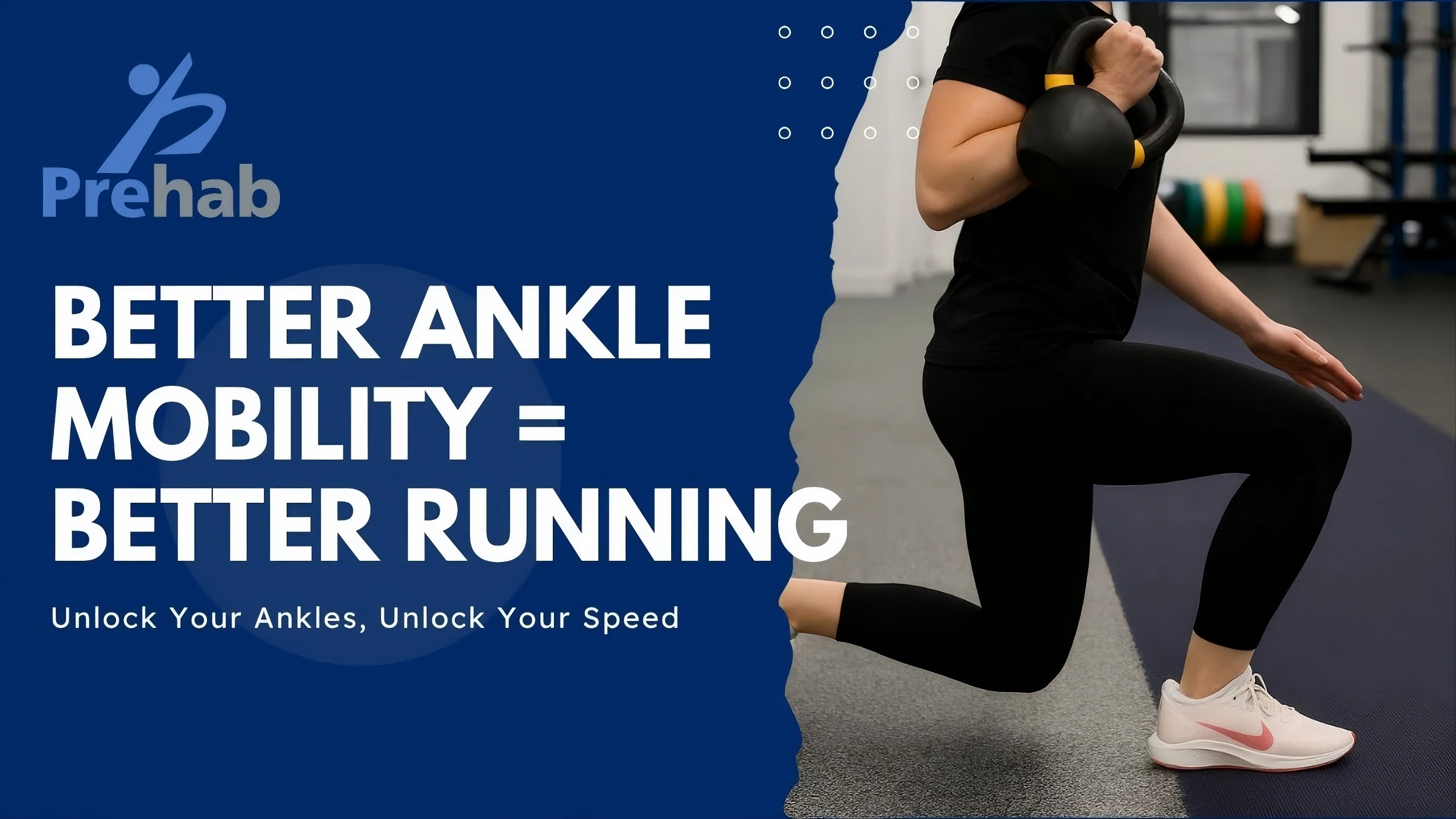
If you have been dealing with tight calves, stiff ankles, or a stride that feels more clunky than effortless, you are not alone. Most runners spend tons of time focusing on hip strength, core stability, or finding the perfect pair of shoes, yet they completely overlook the foundation of every single footstrike: the ankle joint.
If your ankles can’t move freely through a full range of motion, your body has to compensate somewhere else. That usually means your calves overwork, your knees absorb extra impact, and your stride loses that natural, springy efficiency.
At Prehab, we see this all the time. The good news? A little targeted mobility work goes a long way toward fixing it.
Watch on YouTube: https://www.youtube.com/watch?v=MxpW4yI2e28
Why Ankle Mobility Matters More Than You Think
Every time your foot hits the ground, your ankle needs to bend forward—a movement known as dorsiflexion. Proper dorsiflexion allows your body to pass smoothly over your foot during mid-stance.
When your ankles are locked up:
- Shock absorption suffers: Instead of your ankle joint and calf muscles naturally absorbing ground reaction forces, that stress travels up to your knees, shins, or hips (hello, shin splints and runner’s knee).
- Push-off loses power: Restricted mobility limits your ability to extend through the back of your stride, shortening your step and draining your power.
- Running feels like work: A stiff ankle creates a choppy, inefficient stride that burns unnecessary energy over longer distances.
Whether you’re training for your first 5K or working toward a marathon PR, mobile and resilient ankles are non-negotiable for staying healthy and running faster.
Key Mobility Drills to Try Today
To help you get started, we’ve put together a quick video breakdown showing the exact mobility drills the Prehab team uses with runners to improve ankle dorsiflexion and calf compliance.
Here’s a quick preview of what you should focus on:
- Knee-to-Wall Mobilizations: Stand facing a wall in a short stance. Keep your heel glued to the ground and drive your knee straight forward toward the wall. Focus on smooth, controlled repetitions rather than forcing the movement.
- Loaded Ankle Dorsiflexion: Use a light kettlebell or dumbbell resting on your thigh while sitting in a deep squat or half-kneeling position. The gentle weight helps guide the ankle joint into deeper bending without straining the tissue.
- Eccentric Calf Drops: Step onto the edge of a box or curb. Lower slowly on one leg below the step level to build both strength and dynamic length in the Achilles tendon and calf complex.
Pro Tip: Consistency beats intensity every time. Spending just 3 to 5 minutes doing these drills before your runs can make a noticeable difference in how smooth your stride feels.
Train Smarter, Run Stronger
You don’t need to rebuild your running form from scratch to see massive improvements in your performance and comfort. Sometimes, simply giving your ankles the room to move is all it takes to unleash a faster, smoother stride.
Disclaimer: This blog is intended for educational purposes only and should not replace individualized medical or nutrition advice. Always consult with a qualified healthcare provider or registered dietitian for recommendations specific to your needs and training goals.
Why rehab when you can Prehab?
Up Your Game With A Prehab Free Discovery Visit